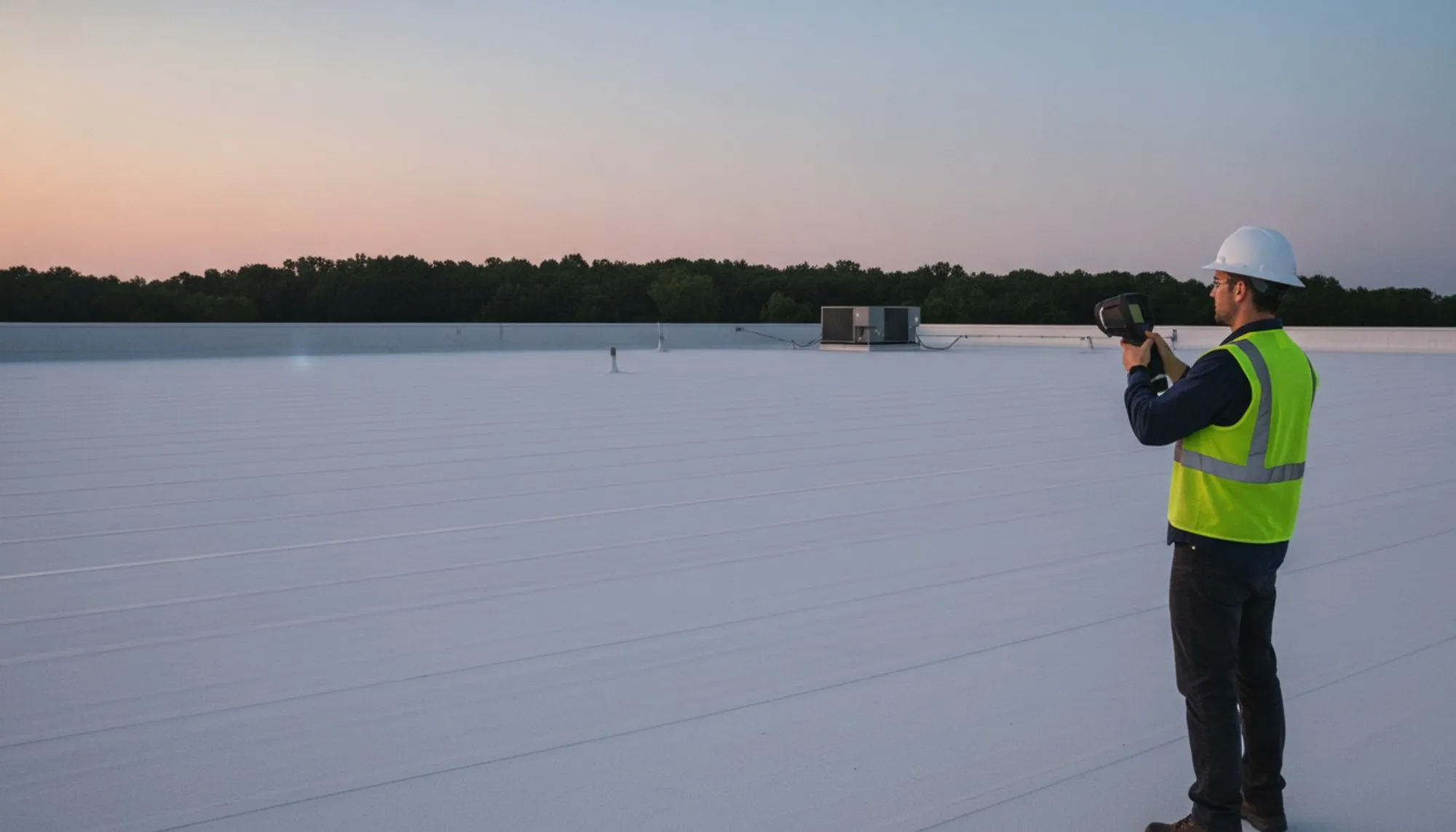
Cover a very large roof in a single night.
An infrared roof moisture survey maps wet insulation from the heat it holds after sunset: saturated areas stay warm while dry roof cools, and the camera reads the difference. On an exposed commercial roof it is the fastest and least expensive way to find out what is wet, delivered as a marked roof plan.
Where it is the right call
A large, exposed, single-ply roof with nothing sitting on top of it. South Florida has a great deal of that on newer industrial, distribution and institutional stock, and on those buildings infrared is the efficient answer: it covers enormous areas in one visit, touches nothing, and costs less per square foot than any alternative.
Through the day the roof takes on solar gain. Saturated insulation holds far more heat than dry insulation around it, and after sunset the dry areas cool quickly while the wet areas stay warm. Scanned in that window, the wet zones are unmistakable. We mark them on the roof itself and record every one.
Where it is not, and we will tell you
Infrared needs a clear evening following a day of real sun, a dry surface, and not much wind. A survey run in the wrong conditions produces a picture rather than an answer, so the survey gets scheduled on an evening that qualifies, which Florida offers in every season.
It also cannot see through things. Ballast, pavers and cover boards block it, and a roof that has been recovered two or three times, which is most older Florida's commercial stock, is a stack of assemblies infrared only reads the top of.
On those roofs the honest answer is nuclear, which measures moisture inside the insulation regardless of what is on top and works in daylight in any weather. We carry both, so telling you that costs us nothing.
Infrared survey questions
When can an infrared roof survey actually be run in Florida?
The survey needs a day of real sun, a dry membrane, low wind, and a clear evening. The scan runs after sunset, when wet insulation holds the day’s heat and dry roof cools around it. Florida supplies those conditions year-round, so scheduling means picking a suitable evening. There is no season to wait for.
Will infrared work on my roof?
If it is a large, exposed roof with nothing on top of the membrane (typical newer industrial, distribution and institutional stock), yes, and it is the most economical survey there is. If the roof carries ballast, pavers, or two or three generations of recover, infrared only reads the top of the stack, and the honest answer is a nuclear survey instead. We carry both.
What does an infrared roof survey cost?
Per square foot, it is the least expensive moisture survey: one visit covers an enormous area with nothing cut or opened. The drivers are roof area, access, and mobilization, and booking it alongside nuclear or electronic leak detection shares the trip.
Do you fly the survey or walk it?
Either. A walked survey lets us mark the wet areas on the roof surface itself; a drone covers very large or unwalkable roofs. We match the platform to the roof and say which one the job needs.
What you get
A marked roof plan with the wet and dry areas delineated and the boundaries drawn, so the work can be priced and a board or an adjuster can read it. The areas marked on the roof surface as well. The conditions on the night and the limits of the survey stated in writing.
Independent testing only. We do not sell roofing and we do not do the repairs.