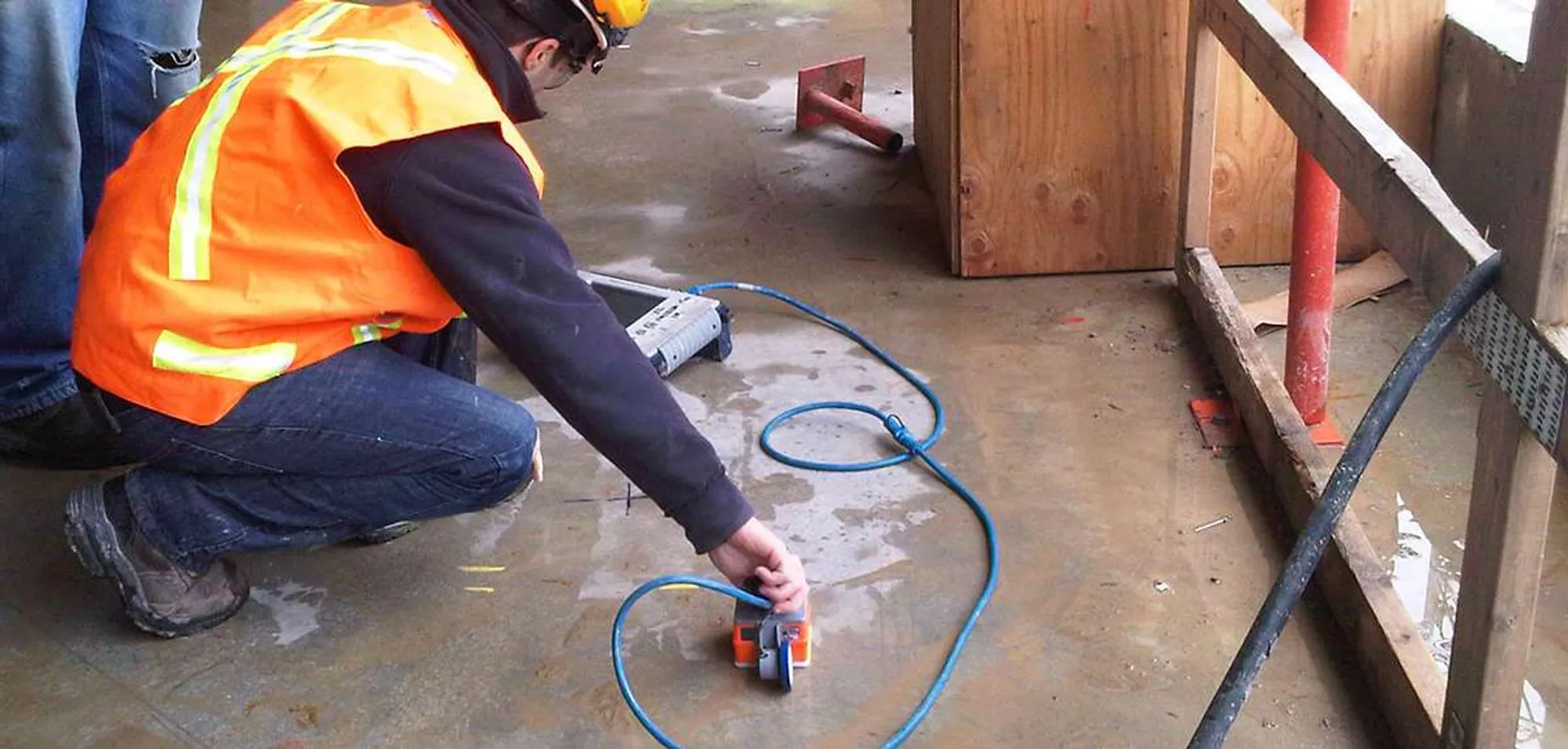
Concrete scanning & imaging
Concrete scanning, also called concrete imaging or loosely "concrete X-ray," uses ground-penetrating radar to see inside a slab, wall or bridge deck before anyone drills into it. The scan reads up to 18 inches deep from one side, without touching the structure, and maps the rebar, post-tension cables, conduits and voids that are waiting in there for the core rig.
When you need this
Any time steel is about to meet concrete blind. Core drilling for new plumbing or electrical runs, saw-cutting a trench, anchoring into a post-tensioned deck, or any penetration of a slab whose as-builts are missing, wrong, or thirty years old, which is most of them.
Contractors of all trades, along with engineers and architects, use the scan to clear locations for core drilling, trenching and saw cutting; to map rebar, wire mesh and post-tension cable; to determine slab thickness and find air voids; and to trace conductive and non-conductive utility lines into and under the slab.
What the radar resolves
Depth penetration at high resolution, deeper than traditional invasive checks reach without destruction.
Resolves the second layer of rebar, subject to spacing.
Detects conduits and pipes including non-conductive plastic, plus post-tension cables and air voids.
Generally only one-sided access is required, and screed stays in place while rebar is mapped.
Concrete scanning questions
What is concrete scanning called, and is it the same as concrete X-ray?
The method is ground-penetrating radar (GPR), and the service goes by several names: concrete scanning, concrete imaging, GPR scanning, and, loosely, "concrete X-ray." A radar antenna is passed over the surface and reflections map what is embedded in the concrete. If you were told to "get the slab X-rayed" before coring, a GPR scan is almost always what the job actually needs.
What can a concrete scan find, and how deep?
Rebar and wire mesh (including the second layer, subject to spacing), post-tension cables, conduits and pipes (plastic included), air voids, and slab thickness, at depths up to 18 inches at high resolution. Only one-sided access is generally required, and screed does not have to be removed to map rebar in a floor slab.
Why scan before coring or cutting?
Because the expensive mistakes are all invisible from the surface. Severing a post-tension cable is dangerous and costly to repair; cutting an embedded electrical conduit stops the job and can injure the operator. A scan clears the drill, trench and saw-cut locations before steel meets concrete, which is why contractors of all trades, engineers and architects order it as a standard step before steel meets concrete.
What does concrete scanning cost?
The drivers are the number of scan locations, the area to be cleared, access, and mobilization. Against what it prevents (a severed tendon, a cut conduit, a flooded core hole), the scan is a small fraction of the cost of any one of them.
Locating lines beyond the slab is underground utility locating; the full family is under subsurface locating.
Tell us where you're cutting
The structure, the planned penetrations, and when the trades need the clearance. We scan, mark the surface, and document what's below before the drill finds it the other way.