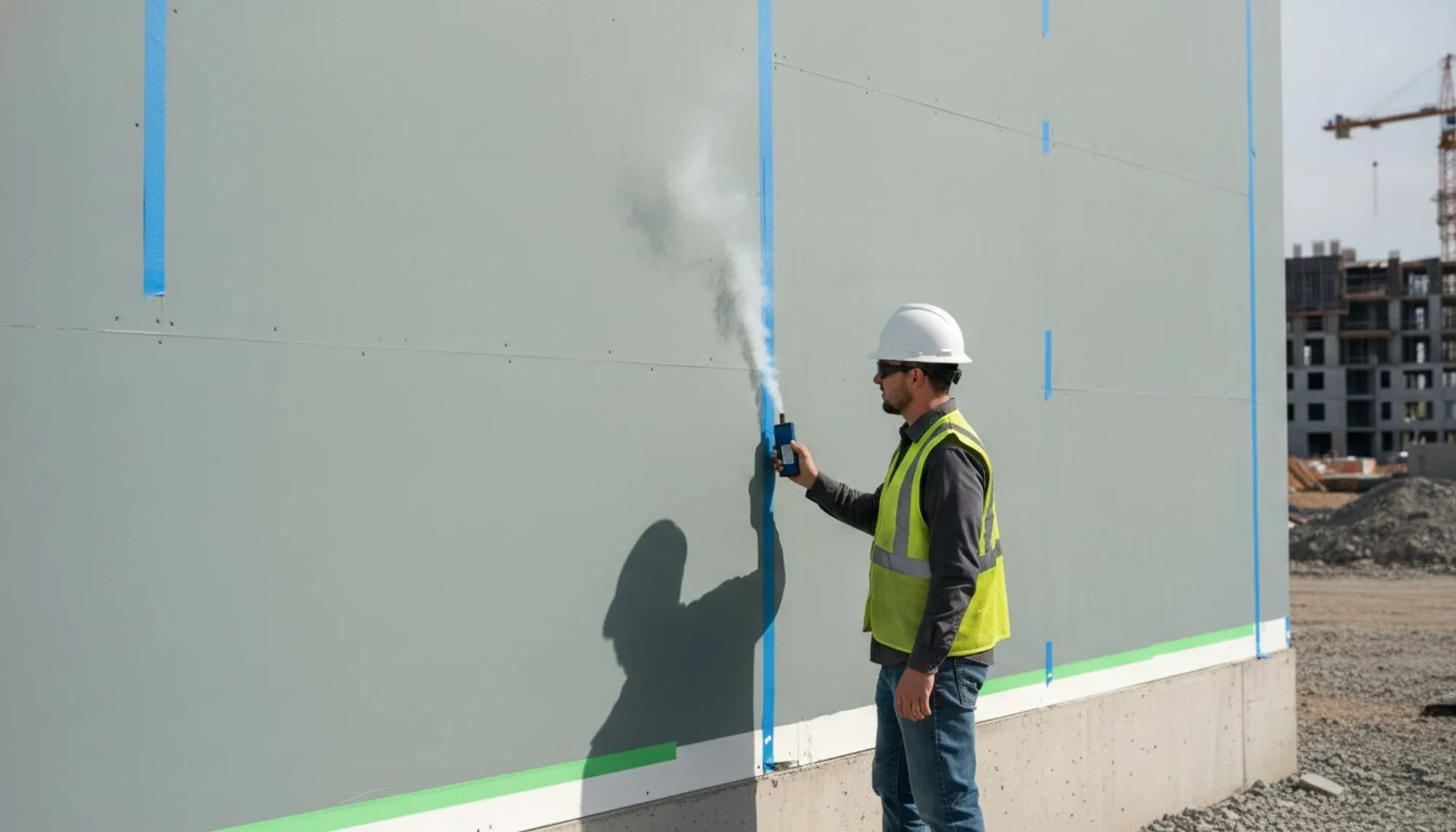
Smoke pencil testing
A smoke pencil makes air leakage visible while it happens. It releases a thin, controlled stream of vapor near the barrier; with a pressure difference across the wall, natural or induced, any moving air pulls the smoke through the gap, and the leak shows itself in real time. Seams, penetrations and transitions get checked one by one.
What a smoke pencil test is
Per ASTM E1186, the test uses visible smoke to trace airflow through the building envelope. With the building under a natural or fan-induced pressure differential, the technician applies the smoke stream to critical details; wherever air moves through the assembly, the smoke follows it and the path is visible on the spot. It is fast, cost-effective, portable, and non-destructive: nothing touches the membrane or the finishes.
Where it earns its place
The classic leak paths
Window and door perimeters, roof-to-wall and wall-to-slab transitions, electrical and mechanical penetrations: the details where envelopes actually leak.
Joints and interfaces
Expansion joints, curtain wall interfaces, and AVB seams and terminations, including chamber-assisted testing where the detail calls for it.
Spot checks mid-construction
Portable enough to follow the work: a suspect detail gets checked the day it is built, marked for repair, and re-tested after the fix.
How a test runs
- Pressure conditions: evaluate natural differential or induce one with a fan.
- Application: apply smoke to the critical building transitions.
- Observation: watch the smoke behavior; moving air marks the leak.
- Marking: leak locations recorded for repair.
- Re-test: after sealing, the same details tested again.
- Reporting: annotated photographs in a final report.
Smoke traces the leak path; bubble gun testing pinpoints membrane defects, and adhesion pull-off testing proves the bond. Most envelope specifications combine them; the whole family is at building envelope testing.
Tell us about the detail
The assembly, the transitions in question, and what the spec or the commissioning agent needs to see. Smoke testing is often same-visit work with the other envelope tests: one mobilization, every method the job calls for.