Commercial Masonry Contractors
The barrier goes on, the veneer goes up, and from that moment any defect behind it costs ten times what it would have cost the week before. There is one honest window to find out whether the installation performs, and it closes when the cladding does.
Specifications increasingly require that testing, and the ones that do not still leave you carrying the risk. If air or water gets through after the wall is closed, the argument about whose work caused it happens years later with the evidence buried.
What we run for you
Air & vapor barrier testing
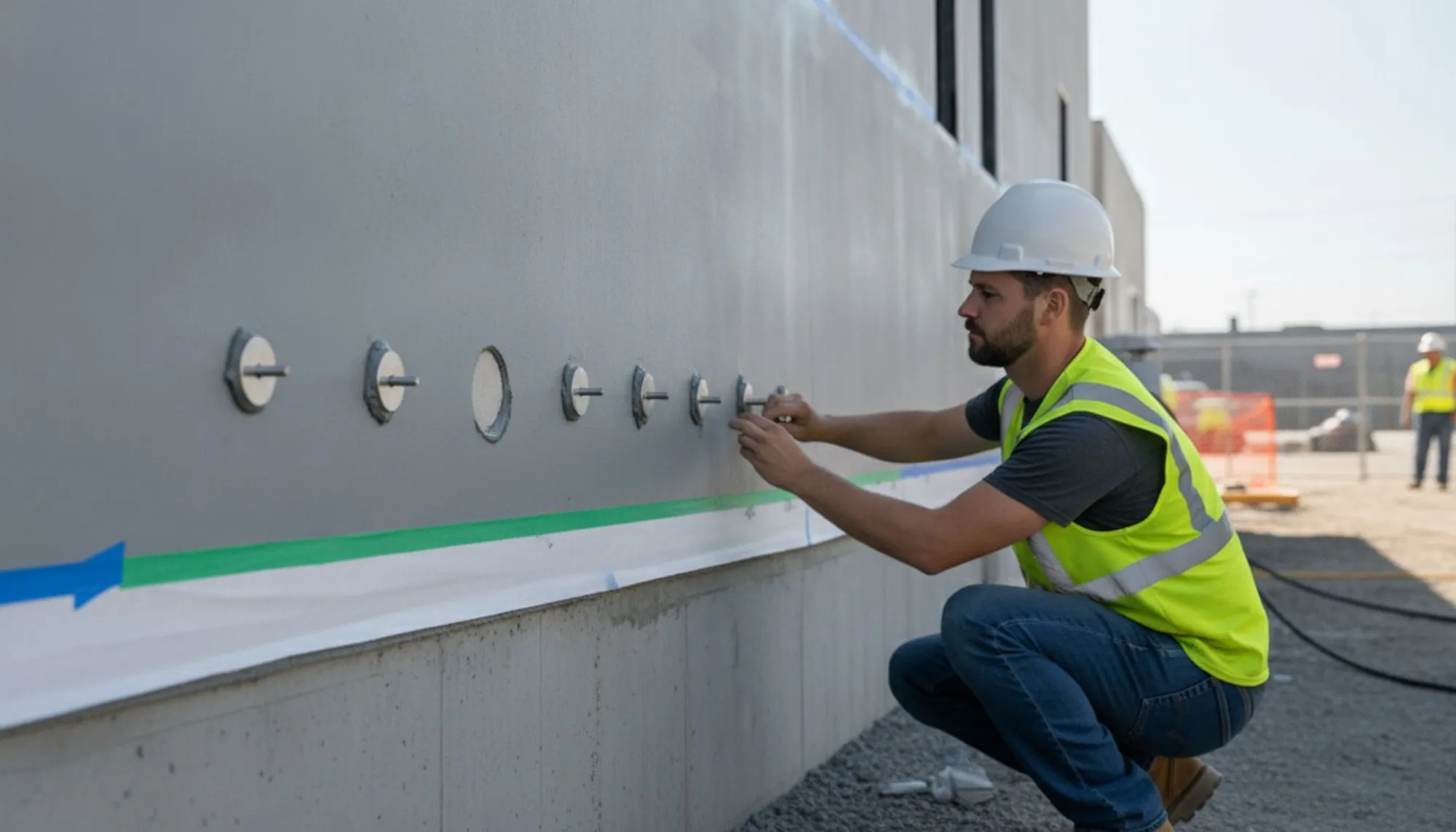
Field quality testing of the installed membrane while it is still exposed, to ASTM E1186 and D4541.
Bubble gun testing
Creates a localized depressurized zone against the barrier so a leak shows itself as bubbles at the exact point of failure.
Adhesion pull-off testing
A calibrated pull that records peak psi and failure mode at each location, which is what a manufacturer or architect asks for when adhesion is questioned.
What you get
Test locations recorded with results, failure modes and photographs, so the wall is documented as compliant before anything covers it.
Testing runs to ASTM E1186 for air leakage location and ASTM D4541 for adhesion, the two standards specifications name for installed barriers.
Questions we hear from commercial masonry contractors
When in the job should the barrier be tested?
After installation and before anything covers it. That is the only window where a defect costs an hour to fix. Once the veneer is up, the same defect means removal, repair and rebuild.
What does the spec mean by ASTM E1186 and D4541?
E1186 covers locating air leakage in the installed barrier. D4541 covers pull-off adhesion: whether the membrane is actually bonded to the substrate at the strength the manufacturer requires. We test to both and report to both.
What if the test finds failures?
Each one is marked and photographed at its location, and you fix it while the wall is still open. That is the point of testing inside the window: the finding is a punch-list item, not a dispute.