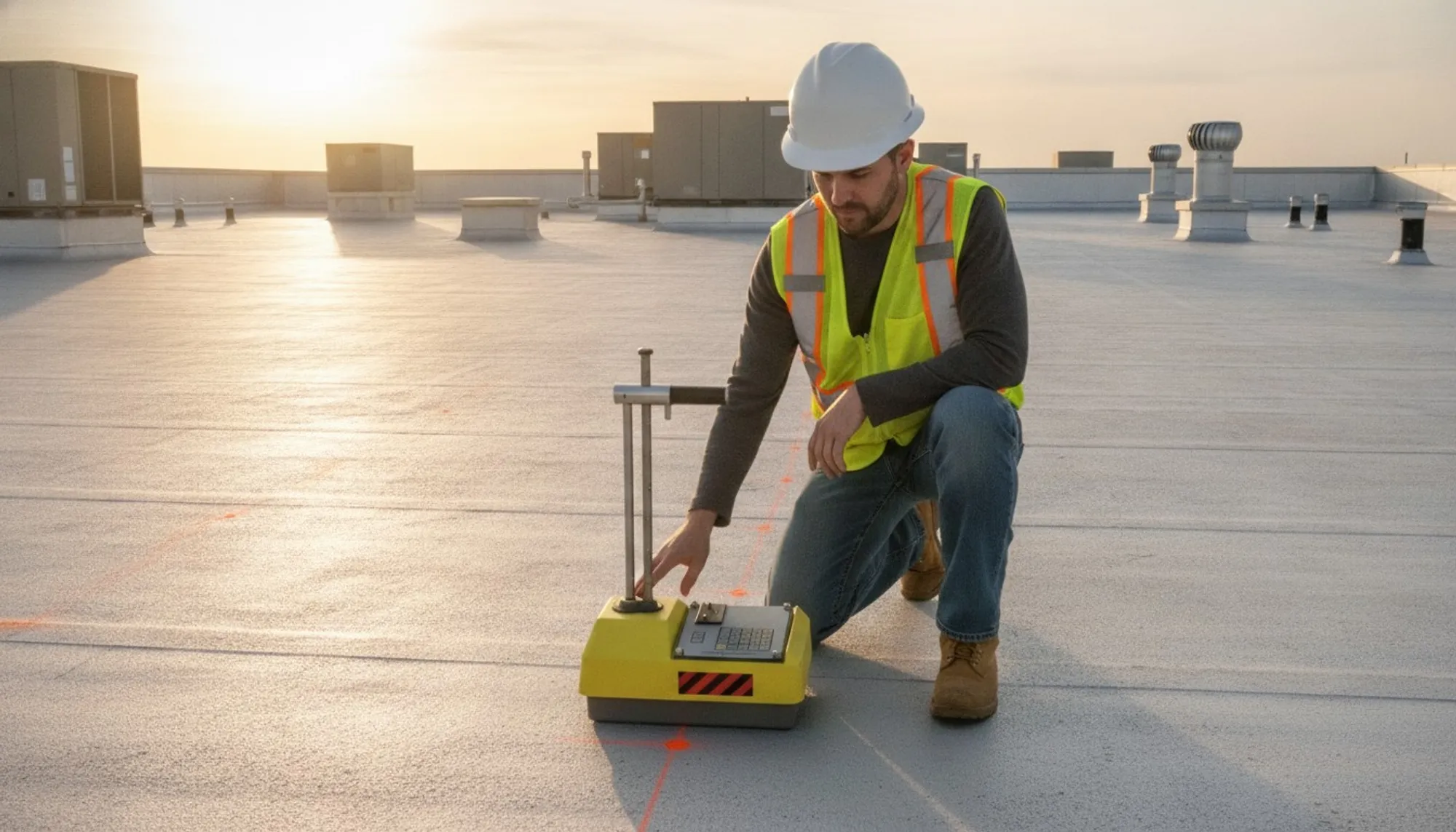
Nuclear roof moisture surveys
Some roofs cannot be read from the surface: ballast, pavers and overlays block a thermal camera, and the moisture hides underneath. A nuclear survey measures the water inside the assembly itself. The gauge takes a reading at each station of a grid, in daylight and any weather, and the stations add up to a moisture map with numbers behind it. A repair-or-replace decision can rest on that.
When this is the right survey
Ballast, pavers, overlays
Everything that blocks a thermal camera is transparent to the gauge. The roofs infrared cannot survey are the reason this method exists, and nothing gets lifted, moved, or opened to run it.
Repair or replace
The expensive mistake is replacing a roof that needed a repair, or repairing one already wet across half its area. The moisture map draws the boundary, so the scope of work matches the scope of the problem.
No waiting on weather
No dusk window, no clear-sky requirement, no season. The survey runs in daylight, on the project's schedule, in nearly any weather.
How the survey works, in plain terms
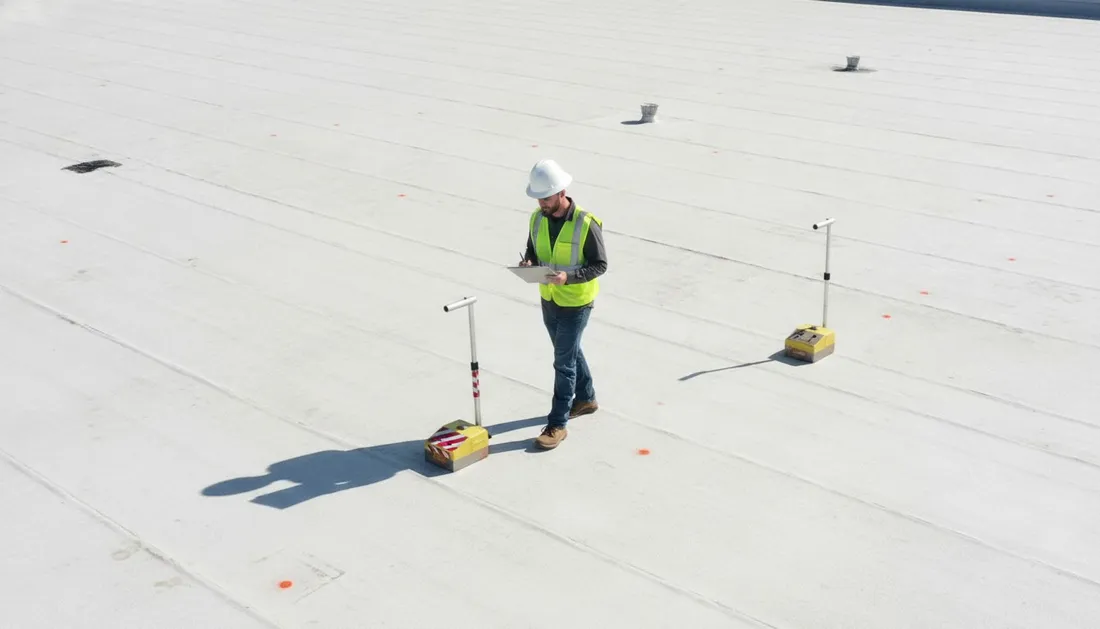
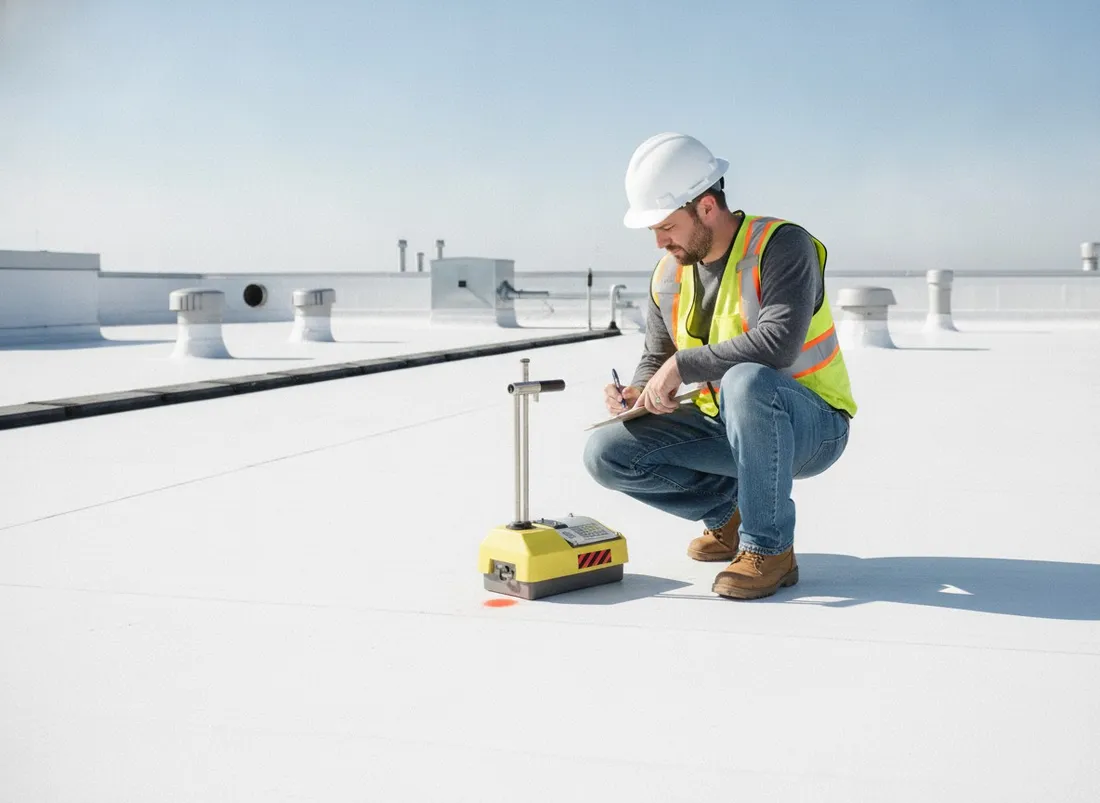
Water is hydrogen and oxygen, and the gauge counts hydrogen. Read at each point of a grid across the roof, it measures what sits in the assembly beneath it: through the ballast, through the overburden, through every layer down to the deck. High counts mean moisture; the grid of readings becomes a map with wet areas bounded and marked.
The survey runs to ANSI/SPRI/RCI NT-1, the standard for detection and location of latent moisture in roofing systems by nuclear thermalization, the one standard that governs this method. Operators are licensed and trained, procedures are standardized, and the report documents the findings together with the site conditions that qualify them.
On a bare membrane with clear evenings available, infrared covers more roof faster; on an exposed membrane in daylight, impedance scans without a radiological source. All three are in-house, and the roof decides. The full comparison is at infrared vs nuclear.
Nuclear survey questions
What is a nuclear roof moisture survey?
A gauge is read at points on a grid across the roof. It counts hydrogen in the assembly below it, and in a roof, hydrogen means water. The readings are mapped, and the map shows where moisture sits inside the assembly, not just at the surface. The method is governed by ANSI/SPRI/RCI NT-1, the standard for detection of latent moisture in roofing systems by nuclear thermalization.
When is nuclear the right method instead of infrared?
When the roof defeats a thermal survey: ballast, pavers, overlays and cover boards that block the heat signature infrared reads, or weather that never opens a usable thermal window. The nuclear gauge reads through the assembly, in daylight, in any weather. On a bare membrane with clear evenings available, infrared covers more roof faster; the roof decides, and we run both. See infrared vs nuclear for the full comparison.
Is the survey safe to perform on an occupied building?
Yes. The gauge is a sealed, purpose-built instrument operated by licensed, trained technicians following standardized procedures. Surveys run on occupied commercial buildings as a matter of routine.
What does the survey tell me, and what does it not tell me?
It maps relative moisture across the roof: which areas read wet, which read dry, and where the boundaries are, which is exactly what a repair or replacement decision needs. It is comparative rather than absolute, it cannot say whether moisture is active or historical, and readings are affected by deck condition, voids and past repairs. The report documents those conditions alongside the findings, so the map you act on says what it can and cannot support.
Tell us about the roof
The assembly, what sits on top of it, roughly how big, and what decision the survey feeds: repair scope, replacement, a claim, a dispute. If a different method reads this roof better, that is what we will tell you.