The roof has been recovered three times. Now what is under it?
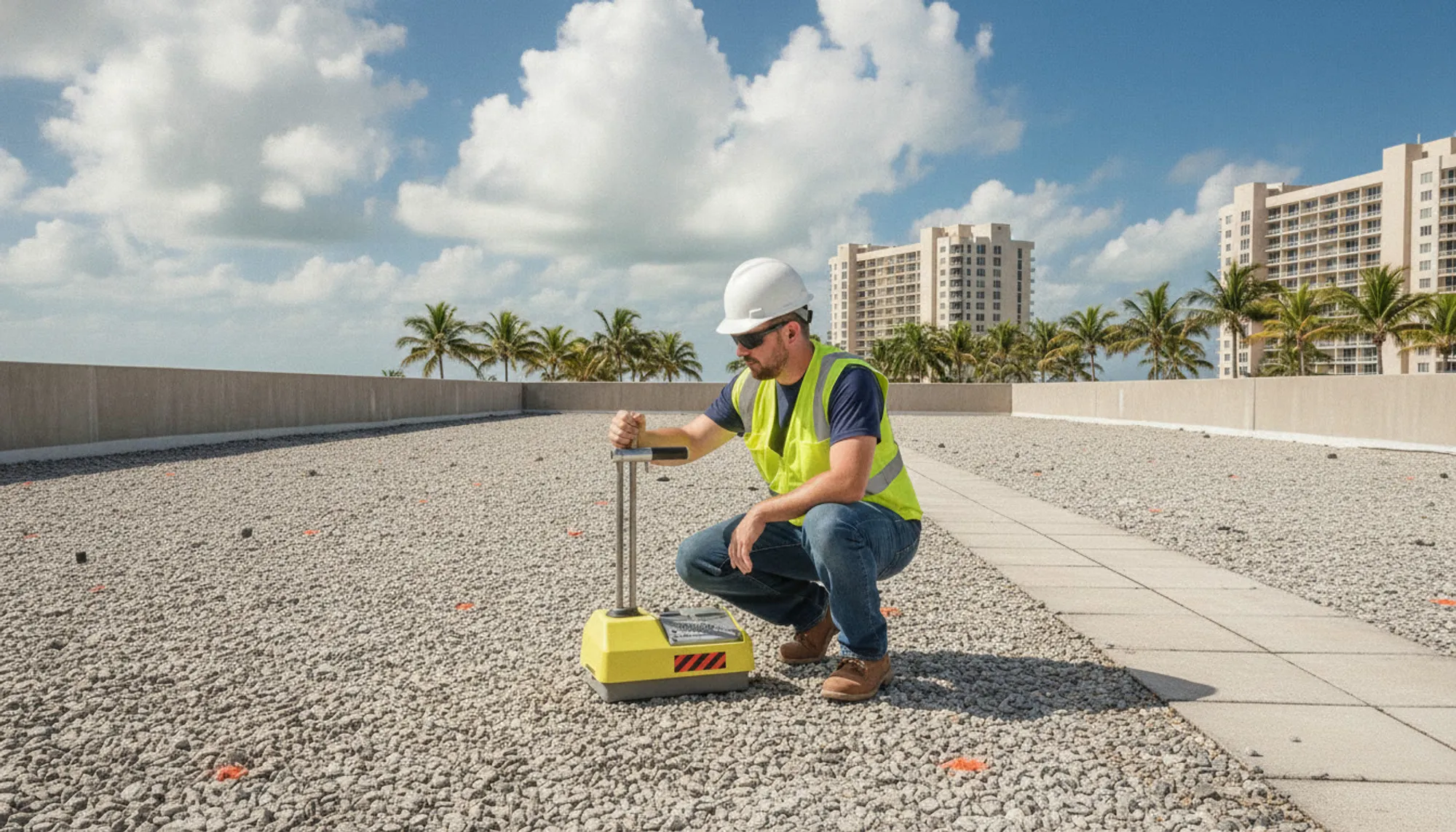
A nuclear roof moisture survey measures the moisture inside a commercial roof assembly, through the overlays, ballast, pavers and cover boards that defeat a thermal scan. Grid readings across the roof produce a quantified moisture map that boards, insurers and specifications can act on. The operators are licensed and the report is independent.
Why Florida roofs defeat infrared
Commercial roofs down here get recovered and storm-repaired repeatedly, and every round adds a layer. What is on the building after twenty years is not a roof, it is a stack: membrane over cover board over an older membrane over the original insulation, with repairs threaded through all of it.
A thermal scan reads the top of that stack. It infers what is underneath from surface temperature after sunset, and once there are layers and overburden in the way, the signal it needs is simply not there to read. Ballast and pavers block it outright.
So the roofs most likely to be holding trapped water are exactly the roofs infrared is least able to assess. That is the gap nuclear fills: it measures moisture within the insulation even beneath added membrane, and it does it in daylight, in any weather, on the day the crew is there.
What the survey is usually for
An association or an owner deciding whether this is a repair year or a replacement year needs to know how much of the assembly is actually wet.
Grid readings across the roof produce comparable values that hold up in a claim file, from a third party with nothing riding on the number.
Where the water is sitting, after a storm or after years of small failures nobody documented.
The roof is usually the largest deferred-maintenance item on a commercial building, and the least visible from the ground.
A moisture map turns a vague tear-off scope into a defined one, which is what stops the change orders later.
Do not tear off dry roof. Do not build over wet insulation.
Those are the same survey and opposite mistakes, and both are expensive.
Replacing an entire assembly when a third of it is wet is money spent on roof that had years left. Accurate moisture mapping keeps the sound sections and prices the failed ones.
The other way round is worse. Recovering over saturated insulation seals the water in, under a brand new roof, with a fresh warranty that will not cover what happens next. On a multi-layer Florida roof, that is exactly the mistake an infrared survey cannot protect you from, because it could not see the wet insulation in the first place.
Nuclear survey questions
Is a nuclear gauge safe to use on an occupied building?
Yes. The gauge contains a small sealed radioactive source, and it is operated by licensed technicians under a state-issued radioactive materials license. Nothing is cut, nothing is opened, and the survey runs on the roof surface while the building stays occupied below.
Why not run an infrared survey instead, since it costs less?
On a clean, exposed, single-layer roof, infrared is the right first call, and we will say so. But most older Florida commercial roofs have been recovered or storm-repaired more than once, and infrared only reads the top of that stack, and ballast and pavers block it outright. Nuclear measures moisture inside the insulation regardless of what is on top. We carry both methods, so the recommendation is not a sales pitch.
What does a nuclear roof moisture survey cost in Florida?
The drivers are roof area, the reading-grid density the job calls for, and mobilization. Booked together with infrared or electronic leak detection, the methods share one trip. Against the alternative (tearing off dry roof, or recovering over wet insulation under a fresh warranty), the survey is a small fraction of the money it protects.
Do you work outside Palm Beach, Broward and Miami-Dade?
Yes. Crews take projects anywhere in Florida.
Who we do this for
Condominium associations and ownership boards, facility and property managers, and the commercial roofing contractors who would rather hand a board an independent report than argue about their own numbers.
Crews run these surveys anywhere in Florida. On a roof of this size the testing is a small fraction of the project, and what turns up is a licensed nuclear gauge and an operator qualified to run it, which most firms cannot put on site.
We are not roofers. We do not install, we do not repair, and we do not bid the work the survey points to.