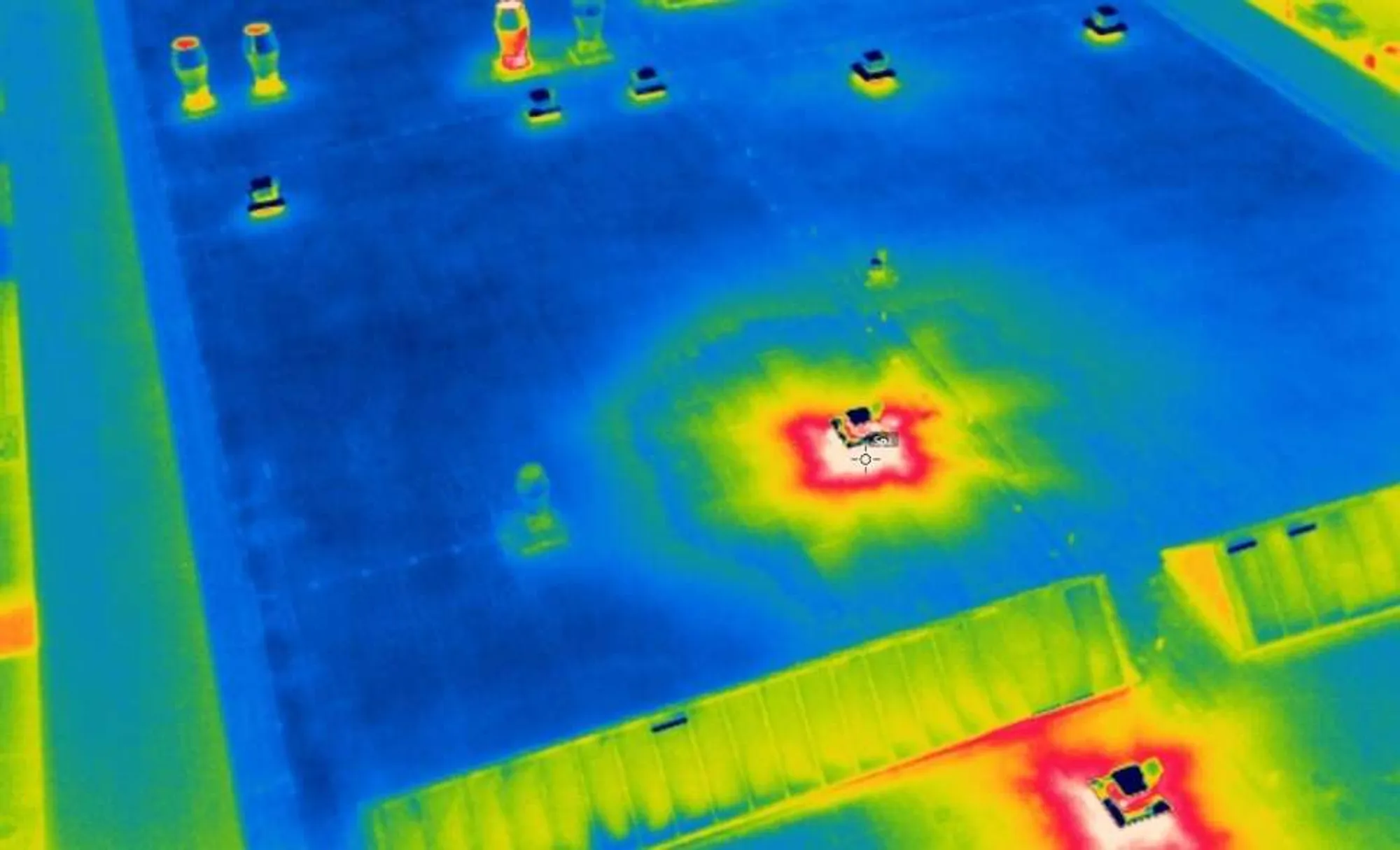
Infrared vs nuclear roof moisture surveys
Both find wet insulation. They find it in completely different ways, and the right one depends on your roof, your surface, and what the weather is doing. We run both, so we have no reason to steer you.
The two surveys, side by side
Infrared
How it works: wet insulation stores more heat than dry insulation and releases it more slowly. After a sunny day, as the roof cools, the saturated areas stay warmer and appear on a thermal scan.
Strengths: fast over large areas, touches nothing, and gives an immediately readable picture of the whole roof.
Limits: it needs the right conditions: a clear evening following a sunny day, with the roof dry. Ballast, pavers and heavy overburden block the signal. A wet surface or a windy night can wash the pattern out.
Nuclear
How it works: a gauge measures hydrogen content through the assembly, which in a roof effectively means water, taking readings at marked points on a grid.
Strengths: works in daylight, works in most weather, and reads through surfaces infrared cannot see past. Readings are numbers rather than an image, which some specifications prefer.
Limits: slower, because someone walks the grid. Resolution is the grid spacing, so it maps areas rather than exact boundaries. Involves a licensed source, with the handling requirements that carries.
How we choose
Large open roof, decent forecast, no ballast: infrared, and you get the whole picture in one visit.
Ballasted or paved roof, tight timeline, or weather that will not cooperate: nuclear.
Big decision riding on it, a full tear-off versus sectional replacement? Then often both: infrared to find the suspect areas quickly, nuclear to confirm the boundaries before anyone prices the work.
Read the service detail
Infrared roof moisture surveys
The evening scan: whole-roof coverage, marked in paint and mapped.
Nuclear roof moisture surveys
The grid survey: daylight, most weather, any surface.
The article on this question
Our published piece on the same comparison.
Tell us about the building
Describe what you have and what you are seeing, and we will tell you which survey fits, or that neither does.