Air vapor barrier testing
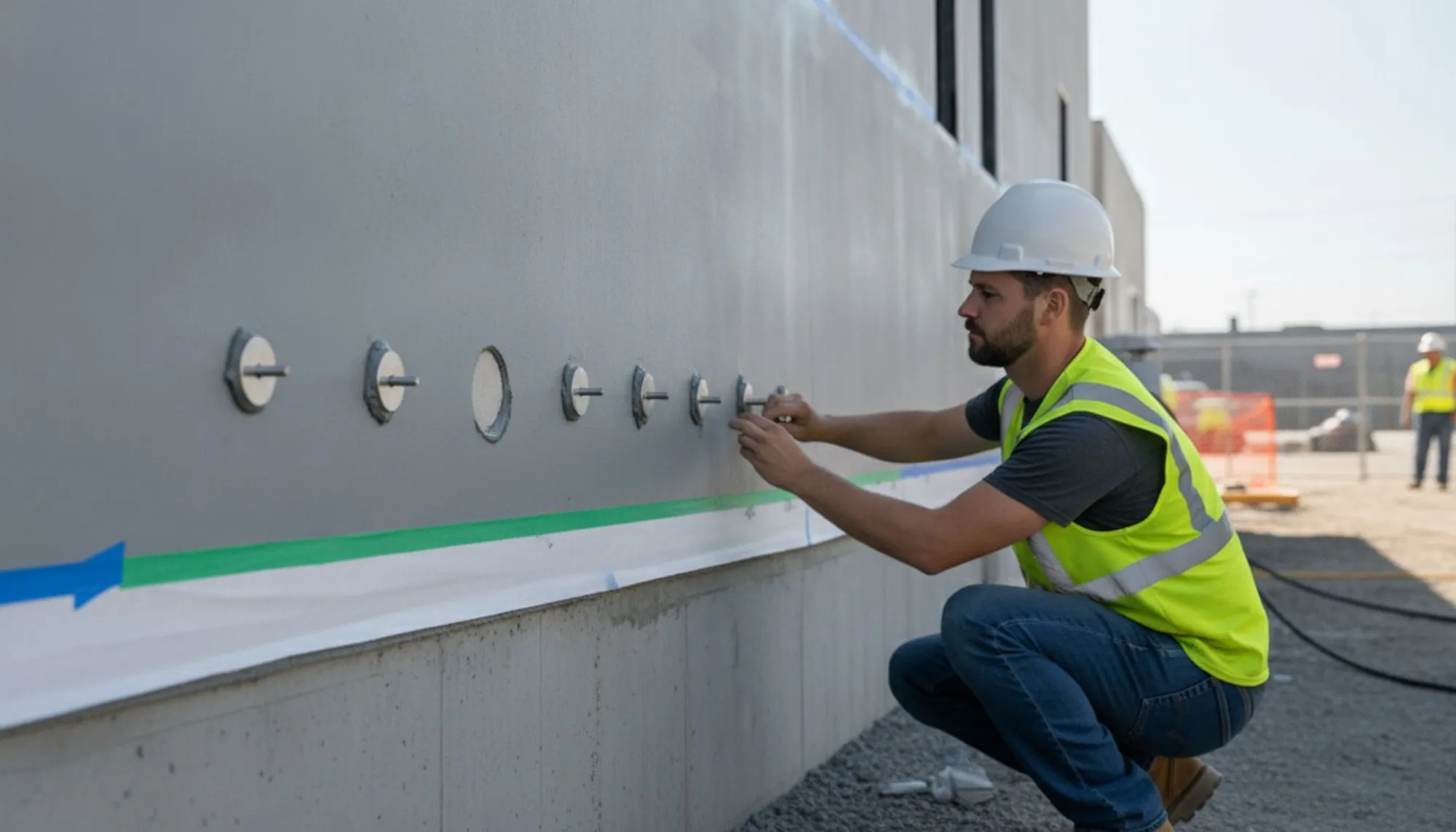
Air vapor barrier (AVB) testing is field quality assurance of the barrier membrane after it goes up on a wall. Two things can be wrong with an installed barrier: it leaks somewhere, or it is not properly stuck. Bubble gun and smoke pencil testing find the leaks, ASTM D4541 pull-off testing proves the bond, and all of it happens while the cladding is still off, documented for the spec and the warranty.
The wall's most important layer gets one testing window
The AVB membrane is what makes a wall assembly work: moisture control, energy performance, indoor air quality, and the durability of everything behind the cladding depend on it. And it's buried for the life of the building the day the cladding goes on.
That gives it one honest testing window: after installation, while it's still exposed. A lap that fails a smoke pencil test today is a patch and a re-test. The same lap found two years from now is an investigation, a dispute, and somebody's cladding coming off. Independent field QA in that window is the cheapest insurance an envelope spec can buy.
Continuity, then adhesion
Bubble gun testing
A localized depressurized zone drawn on the barrier's exterior face: interior air escaping through any defect blows bubbles in a surfactant at the exact point of the breach. Oversized penetrations get a sealed chamber, depressurized the same way. Fast, visual, and definitive.
Smoke pencil testing
A controlled smoke stream held to seams and transitions; moving air pulls the smoke through any discontinuity, making an invisible leak path visible on the spot.
Adhesion pull-off testing
A dolly bonded to the membrane and pulled perpendicular until it detaches or the spec threshold is reached, recorded in psi with the failure mode, per ASTM D4541, on a calibrated hydraulic tester.
Rounded out where the spec requires it: thickness measurements and visual continuity inspections across the installed field. Every finding lands in an objective report (location, photo, result) that project teams use to verify compliance and close punch items early.
Verification, not installation
Building owners, architects, envelope consultants, construction managers, and commissioning agents use ATS because we test and report; we install nothing and repair nothing. On a QA test, that independence is the point: the report reads the same whether the finding helps or hurts the installer, which is exactly why specs accept it.
Our published test and material specifications, including paste-ready scope language, are on the specifications page.
Diagnosing a finished building rather than a membrane under construction? That's infrared building envelope testing, a different service for a different moment.
What specifiers ask
What is air vapor barrier testing?
Field quality testing of the air/vapor barrier membrane after installation on a wall assembly. It answers two questions: is the membrane continuous, with no leaks at laps, penetrations, and transitions, and is it properly adhered to the substrate. Bubble gun and smoke pencil testing answer the first; ASTM D4541 adhesion pull-off testing answers the second.
When in construction does AVB testing happen?
While the barrier is still exposed: after installation, before cladding or insulation covers it. That window is the whole value: a lap that failed testing costs a patch while the wall is open, and a dispute plus demolition after the cladding goes on.
Which test does my spec require?
Most envelope specifications call for adhesion verification to ASTM D4541 plus a leak-detection method on the installed membrane; some add thickness measurement. Send us the spec section and we will confirm scope, method, and frequency; our own published test specifications are on the specifications page.
Is this the same as building envelope testing?
It is one piece of it. Building envelope testing covers the tests that find where a wall, roof or barrier assembly leaks air or water. AVB testing is the construction-phase piece: it verifies the barrier membrane itself while correction is still cheap. Diagnosing a finished building with a thermal camera is infrared envelope testing, a different test in the same family.
Send us the spec section
Project, barrier system, and the QA language in the spec. We'll confirm method, frequency, and schedule the testing inside your construction window.