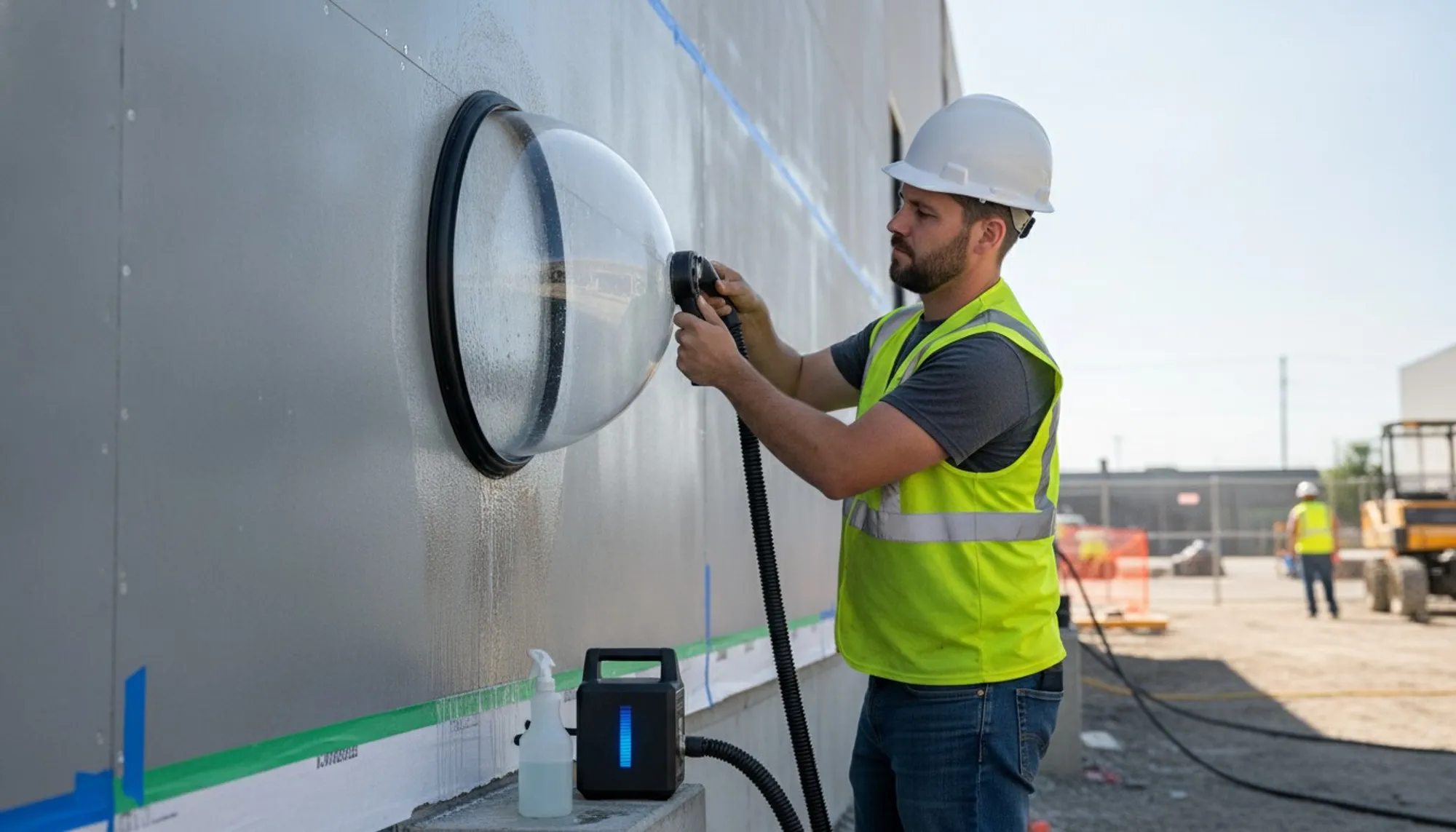
Bubble gun testing
We pull a light vacuum over a small area of the barrier's exterior face and wet it with a surfactant solution. If the membrane is breached anywhere in that zone, by so much as a pinhole, air from inside the wall escapes through the defect and blows bubbles at its exact location. The leak is found while the barrier is still exposed and cheap to fix.
What bubble gun testing is
Bubble gun testing, per ASTM E1186, finds air leakage sites in an installed air/vapor barrier by making them visible. A biodegradable surfactant (bubble solution) is applied to the membrane, and the test instrument creates a localized depressurized zone against the exterior surface. An intact barrier shows nothing. A breach lets interior air through, and the escaping air foams the solution into bubbles the technician can see, mark, and photograph in real time.
It catches exactly the defects that cause air barriers to fail in service: fastener penetrations, trowel skips, and missed detailing at transitions, found now, while the fix is a dab of sealant instead of opening finished cladding.
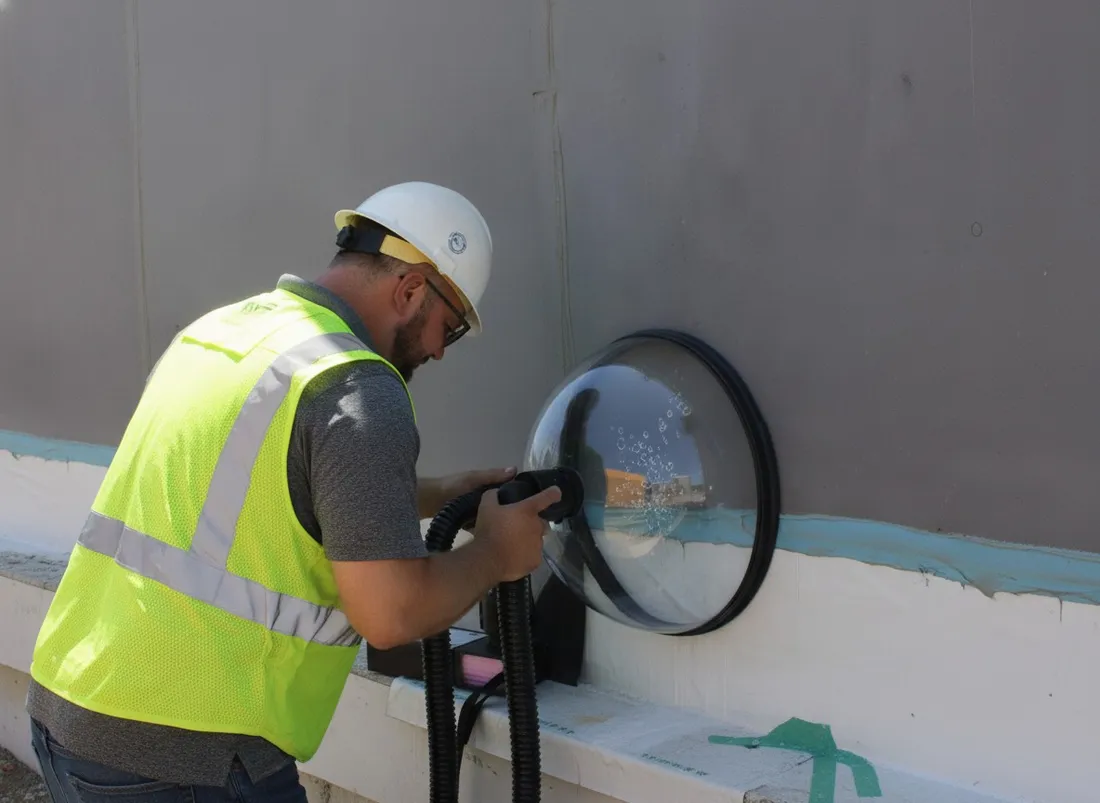
Chamber testing, for what the handheld tester can't cover
Some penetrations are bigger than the handheld instrument's test area: a cluster of pipes, a duct, structural steel through the barrier. Those get a custom test chamber, a frame built around the penetration on site, sealed to the barrier, and depressurized the same way. The surfactant, the bubbles, and the documentation all work the same, and the size of the detail does not exempt it from the test.
How a test day runs
- Site setup: confirm the AVB is fully cured, exposed, and accessible.
- Surface preparation: apply the biodegradable surfactant to the target zones.
- Depressurization: draw the localized test zone against the barrier; build and seal a chamber where a penetration outsizes the instrument.
- Leak detection: watch the bubbles form at every leakage point.
- Documentation: mark and photograph each defect in real time.
- Re-test: after repairs, test the same points again to confirm the seal.
- Reporting: annotated images and a pass/fail summary the project can act on.
Where the test earns its place
Systems and substrates
Fluid-applied and sheet AVB systems over concrete, CMU, or sheathing: non-invasive, and safe on active or occupied buildings.
High-risk details
Curtain wall transitions, expansion joints, penetrations: the zones where air barriers actually fail, tested one by one.
Compliance and QA
ASTM E1186 procedures supporting ABAA requirements, manufacturer warranties, energy codes, and LEED or Passive House QA programs.
Bubble gun testing is one of the envelope methods carried in-house; see the whole family at building envelope testing, tracer smoke at smoke pencil testing, and bond strength at adhesion pull-off testing.
Tell us about the barrier
The system, the substrate, what stage the installation is at, and any spec or warranty requirement driving the test. You will get which test the job needs, and what it costs.